
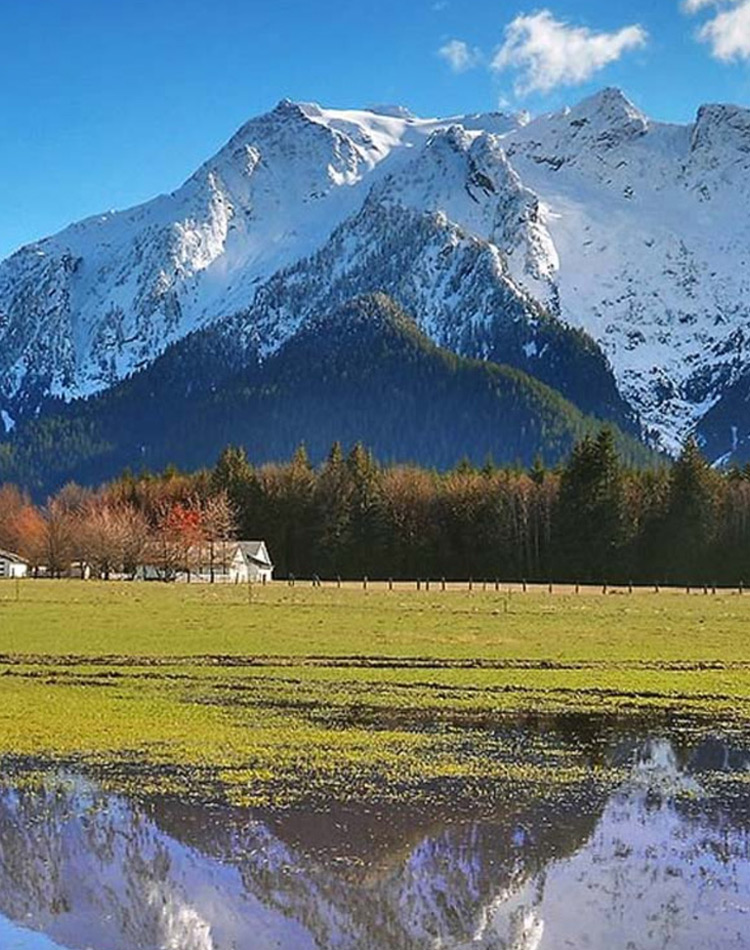
Darrington, Washington remains a small mountain town, its natural beauty intact as a gateway to the North Cascades. The dominating presence of Whitehorse—named for the equine-shaped glacier on the mountain’s north face—towers above town to the southwest; the clear waters of the Stillaguamish and Sauk rivers establish boundaries to the west and east, respectively. Yet the ebb and flow of natural resource extraction, that so frequently determines the fate of rural communities, eventually caught up with Darrington, just as it had in western North Carolina decades prior. The parade of log trucks that once shuttled along the Arlington-Darrington highway has largely subsided, the town relying more heavily on tourist draws in the form of outdoor recreation and music festivals. In contrast, the mid-century Darrington that Fred McFalls encountered upon his arrival was riding a postwar surge, still humming with the din of lumber mills.
Originally settled with intent to develop mineral resources, Darrington’s economy quickly began turning toward the forests with the arrival of the railroad at the turn of the century. Initially, small lumber mills and shingle mills generated the great majority of the town’s income, but as the United States Forest Service opened larger tracts of land for resource development in the 1910s and 1920s, the timber industry hit its stride, and Darrington entered its logging heyday. This era saw the first waves of Tar Heels emigrate west from North Carolina, with one mill in the neighboring Skagit Valley recruiting three railcar loads of workers in the early 1920s, covering the cost of transportation, and providing housing for families upon arrival.
Surrounded by towering forests rich in fir, hemlock, and cedar, loggers used crosscut hand saws to fell four- to nine-foot diameter firs, and sixteen- to seventeen-foot cedars. By the late 1920s, the Sauk River Lumber Company was loading over a million board feet of timber every other day, employing nearly 300 men in its movable logging camp. Darrington’s economy had become almost entirely dependent on the timber industry when the Great Depression took hold, and like much of the rest of the country, struggled for several years to regain its footing.
By the postwar years of the late 1940s, traditional large-scale logging camps had been displaced by the greater maneuverability of truck logging. This opened the door for small-scale, independent outfits, who frequently contracted with larger companies like Scott, Weyerhaeuser, and Georgia-Pacific, earning a certain amount per thousand board feet of timber harvested. During the height of truck logging in the 1950s and 1960s, dozens of trucks could be heard shuttling logs in and around Darrington on a daily basis. Many loads ended up at the Three Rivers Mill in Darrington, which was taken over by the Summit Timber Company in 1959. The Summit Mill became Darrington’s largest employer, with approximately 300 workers in 1974, and remains so today under the ownership of Hampton Lumber Company, despite the continued fluctuations of the timber industry.
The McFalls Family
When I first began researching the history of bluegrass music in the Pacific Northwest, the late Phil Williams emphasized the role of Fred McFalls and his wife, Alice, as the “de facto leaders” of the Tar Heel bluegrass community, emanating from Darrington, Washington. Subsequent conversations with Phil’s wife, Vivian Williams, and Irwin Nash, each of whom played critical roles in developing the bluegrass community in Washington State, only served to underscore Phil’s proclamation. Though Fred was not the first North Carolinian to bring his musical talents to western Washington, he is widely acknowledged for founding the first professional bluegrass band in the region, the Carolina Mountain Boys, while also being recognized as the area’s top bluegrass-style banjo player in his day. Additionally, he and Alice opened their home to a growing number of young, would-be bluegrassers, who were branching out from the greater Seattle folk scene of the 1950s and 1960s, fostering the growth of a thriving bluegrass community far beyond the town limits of Darrington.
Like many of the self-identified Tar Heels that settled in Darrington, Fred McFalls grew up in rural Jackson County, North Carolina, nestled in the Great Balsam Mountains, a subrange near the southern end of the greater Blue Ridge province. Fred was raised on a family farm in Caney Fork, a small community near Cullowhee and the town of Sylva. “They were out on a mountain,” says daughter Janie McFalls-Bertalan, “and they all kind of just lived in the same area. It was way out in the sticks, where he grew up.” Though he only attended school through the third grade, Fred was a motivated learner. It wasn’t until later in life that he began to seriously read, which he learned by methodically working his way through the family Bible.
Having joined the Army at the onset of World War II, Fred was sent to basic training at Fort Jackson (South Carolina) in February of 1942. Ultimately serving in the European theater during the war, a news clipping back home, dated March 28, 1945, highlighted his contributions in the final weeks before Germany’s unconditional surrender: “Pfc. Fred McFalls, Gunner, son of Mrs. Timey McFalls, of Cowarts, is a member of the 173rd Field Artillery Battalion, which recently fired its 110,000th round into German positions on the Fifth Army front in Italy.” At the end of the war, Fred returned to western North Carolina, and like many in the area, had a difficult time finding consistent work, ultimately prompting his move to Washington.
.
In 1952, now living in Darrington, Fred found himself driving past Alice Potts’ home while she was out working in the yard. Recounting their meeting, Fred was sure to tell everyone that “she about jumped the fence to get out there to talk to him.” Shortly thereafter, in July of 1952, Fred and Alice were married during a small ceremony at Alice’s parents’ home in Darrington. They celebrated that evening by attending the stock car races in Seattle with friends and family.
A fellow Tar Heel, Alice grew up in Franklin, North Carolina, later moving to Sylva, where her father had taken over the newly renovated Central Esso Station. Prior to their move, Mr. Potts had operated the Lake View Service Station and Tick-Tock Cafe in Franklin where Alice and her sister Esther worked while growing up. Having completed school through the eleventh grade, Alice married Neil Bishop, Jr., in September 1946, and moved to Washington shortly thereafter, where their first child, Jo Ann, was born in Arlington. She was pregnant with their second child, Roger, when Neil passed away at the age of 24.
With the timber industry being the focus of the economy in Darrington, Fred earned his living as a millworker, primarily on the “green team,” where he inspected and pulled bad lumber. By the mid-1960s, a significant portion of the mill was being shut down, and Fred found work at an Everett plywood mill along with two of his friends, who would take turns driving the 100-mile round trip from Darrington each day. Strategically situated along Puget Sound, Everett has historically been one of Washington’s busiest ports for the processing and shipping of forest products.
In 1965, Fred moved the family to nearby Marysville to be closer to his job. Janie was in the fifth grade at the time of the move and ended up finishing high school in Marysville. By 1972, the mill in Everett shut down, and the McFalls family moved to Sandpoint, Idaho, where Fred had planned to open a shake mill with two of his friends from the Skagit Valley. The plan ultimately fell through, and after a few months in Sandpoint, the family moved on to Libby, Montana. Finding work in Libby proved difficult for Fred, but he eventually hired on at a lumber mill, before moving back to Marysville in 1975. The family returned to the same house they had left three years earlier, having rented it out while they were gone, rather than sell. At this point in his life, Fred transitioned away from millwork, instead picking up janitorial work for area schools.
Together, Fred and Alice McFalls would become two of the central figures responsible for establishing a lasting bluegrass music community in Washington State. Fred, as one of the first to perform bluegrass professionally in the state, and eventual mentor to a younger generation of aspiring bluegrass musicians from Seattle; Alice, as gracious host, who welcomed the music in her home, and stood as a shining example of southern—or Tar Heel—hospitality. Alice, in particular, deserves recognition for the often-unseen roles women perform in building bluegrass community, evidenced by her frequent mention during the portions of interviews that dealt with jam sessions at the McFalls’ home. Additionally, Fred and Alice lent their efforts to organizations that would help foster the growth of a bluegrass community in Washington, namely the Timber Bowl event in Darrington and the Tar Heel picnic held every summer in Everett.
Fred and Ben
While Fred was growing up in North Carolina, music was not a major part of the McFalls household. Neither his mother nor his brothers played music, and while his stepfather “had a little bit of music in him,” according to Fred’s daughter, Janie, he did not keep any musical instruments around the house. Eventually, Fred became proficient enough on the guitar that he began playing in a classic brother-style duo with Ben Bryson, a fellow North Carolinian, who played mandolin. Though Janie doesn’t recall Fred saying much about his experiences playing music prior to moving to Washington, he and Ben must have had at least some level of professional ambition, as they made appearances on local radio out of Waynesville, North Carolina.
Fortunately, we don’t have to strain ourselves wondering what Fred and Ben may have sounded like during their early years as a duo. Approximately twenty-five minutes of rare video footage has been preserved for public viewing, an invaluable record of these two pioneering figures in Washington’s Tar Heel bluegrass community. Filmed in the 1960s at the University of Washington, in collaboration between the Seattle Folklore Society and KCTS Channel 9, the opening lines read, “Originally from Sylva, North Carolina, Fred McFalls and Ben Bryson now live in northwestern Washington. Together with a fiddler, they formed the Carolina Mountain Boys and played on the radio in Waynesville, North Carolina during the 1940s.” The camera then cuts abruptly to a close-up of Fred, who introduces an old standard, “The Greenback Dollar,” while Ben prepares to kick it off on his borrowed Gibson F-5 mandolin.
Appearing in matching suits and western bow ties, Fred with his thatch of thick, dark hair neatly slicked back, the duo evokes the professional brother duets of the 1930s. The program continues with two more classic duet arrangements: “Lonely Tombs” and “All the Good Times are Past and Gone.” Ben sings the tenor parts, and Fred handles the lead vocals, providing steady rhythm and snappy bass runs on his Martin D-28. Noted especially for his three-finger banjo playing, he then switches over to a Gibson Mastertone, rendering strong performances of “Maggie Blues” and “Double Banjo Blues,” a nod to his banjo hero, Don Reno.195 Their sound bears resemblance to fellow western North Carolinians, the Morris Brothers, who were active on Asheville, North Carolina’s WWNC radio in the late 1930s,196 when Fred and Ben were still living in nearby Jackson County.
This footage first became known to me as an undergraduate student in 2011, when it was uploaded to YouTube, alongside similar in-studio performances from Roscoe Holcomb, Buell Kazee, Elizabeth Cotton, and several others, each sponsored by the Seattle Folklore Society. At the time, I was studying bluegrass and old-time music at East Tennessee State University, eventually honing my focus on the brother acts that began appearing in the 1930s. Discovering this footage of Fred and Ben was revelatory for me, not only as a recent transplant from the Pacific Northwest, but as a student of this lightly documented subgenre of country music. By the time television overtook radio as the dominant form of media in the 1950s, most of the classic brother duos had either faded into obscurity, or evolved within the arc of country music, incorporating larger bands, and the modern sounds of honkytonk, bluegrass, and rhythm and blues. As such, there are precious few examples of the brother duet style committed to film, greatly enhancing the value of this footage, aside from its import as an artifact of early country and bluegrass music in Washington State.
The Carolina Mountain Boys
The Carolina Mountain Boys are considered by many to be the first professional bluegrass band in western Washington, having formed sometime in the early 1950s, after Fred McFalls moved to Darrington from western North Carolina. Built around Fred’s polished banjo playing, the initial lineup also featured brothers Kenneth and Pritch Chastain on guitars, with Bill O’Connor joining on fiddle. All were originally from western North Carolina. Frankie D. Kannard, a highly skilled fiddle and banjo player, also played with the band during this time, prior to finding fame as “Buster Jenkins” on radio station KLAK’s Rocky Mountain Jamboree out of Denver, Colorado.
Up to this point, newspaper records have revealed little about the performances given by the Carolina Mountain Boys during the 1950s. As such, it is difficult to infer much about the frequency or variety of their typical appearances, or for that matter, the evolution of their lineup over the years. With that said, it is probably safe to assume they would have been called upon to play similar events and venues as their immediate predecessors, the Sauk River Ramblers, who will be addressed in the proceeding pages. This would have included various community functions, such as Darrington’s annual Timber Bowl parade, along with weekend dances at some of the area grange halls.
Fred’s daughter, Janie, highlighted some of the more memorable engagements the Carolina Mountain Boys were involved with during these early years. Once or twice, they appeared on Buck Owens’ Saturday night television show, The Bar-K Jamboree, a half-hour program on Tacoma’s channel 11, KTNT. They also filled in with a young Loretta Lynn, who was just beginning her career in the taverns and grange halls of Whatcom County, in Washington’s northwest corner. “They used to have picking a lot up there, because there was a lot of…Tar Heels that ended up in that area, in the Sedro-Woolley, Birdsview, Lyman, Concrete, Hamilton [areas]—up in there.”
The Chastain brothers, like Fred, had come to Washington, “to see what it was about,” Janie told me. While Fred’s ability to travel long distances with the Carolina Mountain Boys was limited by work and family, the Chastains sought to play more widely in the region, as far away as Montana. Bill O’Connor was also active with other groups at this time, and along with the Chastains, began taking out-of-state gigs as opportunities arose. With this, the early incarnation of the Carolina Mountain Boys began to dissolve, and the Chastain brothers eventually moved back to North Carolina, before the young bluegrassers from Seattle became involved with the Darrington music community.
Fred kept the Carolina Mountain Boys going into the 1960s, never lacking for other musicians to play with. He continued to make music with his friend, Ben Bryson, a carryover from his days in North Carolina. Janie told me Ben was not officially a member of the early Carolina Mountain Boys, but Seattle musician, Irwin Nash, remembers seeing Ben perform with Fred and the Chastain brothers in the 1950s, likely at the grand opening celebration for The Folklore Center in Seattle’s University District.
Newspaper accounts shed light on some of the other area musicians that Fred performed with in the late 1950s and early 1960s. A July 1959 announcement for a “Western Music Concert” at Darrington High School lists Fred McFalls, Bill O’Connor, and Billy Joe Davis as one of the groups performing, citing their earlier appearance on Bill and Grover’s Variety Show, which aired on the same Tacoma television station as Buck Owens’ program. Ben Bryson and Val Crawford are also listed among “The local western music stars,” participating in the Darrington concert, which was to include, “the best in guitar, mandolin, fiddle, and vocal efforts.“ In 1963, the Carolina Mountain Boys were awarded second place string band in the Darrington Timber Bowl fiddlers’ convention, of which Fred was a principal organizer. Their lineup that day included Fred on banjo, Chuck Martin of Lynden on mandolin, Ed Blanton of Darrington on guitar, and Duane Devaney of Bellingham, also on guitar.
Between 1963 and 1964, Phil and Vivian Williams recorded live performances of Fred McFalls and the Carolina Mountain Boys at the Darrington Timber Bowl, as well as a performance hall in Sedro-Woolley that would occasionally host informal bluegrass concerts. From these recordings, two 45 RPM records were produced on a small Seattle record label, Audio Recording Inc., which specialized in affordable, custom pressings for regional performers. Record number AR-107 featured “Pike County Breakdown” on the A-side, paired with “Lonesome Road Blues” on the B-side, while AR-109 included “Paul and Silas” and “Light At The River.” According to the label on AR-107, the band was comprised of Fred on banjo, Chuck Martin on mandolin, Ben Bryson on guitar and vocal, with Phil Williams (“Pike County Breakdown”) or Ed Blanton (“Lonesome Road Blues”) on bass. These appear to be the only semi-commercial records the Carolina Mountain Boys ever made.
As the McFalls children grew older, they began singing and playing instruments themselves. Rather than take formal lessons, they mostly learned by ear, and by watching the grown-ups play during the frequent jam sessions that would take over the McFalls household.
“You’d just have to sit and watch everybody’s hands, and that’s how I picked up the guitar,” Janie told me. “Dad wouldn’t let us touch the instruments. You know, they were [expensive]. So, I would just watch one chord at a time, and that’s how I ended up getting the guitar down a bit.” By early 1970s, as the family navigated moves to Idaho, Montana, and back to Marysville, Fred began to redirect his musical efforts toward their family band, Fred’s Home Grown. Among their notable gigs were appearances at the Spokane World’s Fair in 1974, and the Darrington Bluegrass Festival, from its inception in 1977, through the mid-1980s. With the kids growing up and starting their own families, Fred’s Home Grown eventually ran its course.
Pickin’ the Banjo
For Janie and the other McFalls kids, bluegrass music and the bright, syncopated rolls of Fred’s banjo were part of their everyday lives, growing up in Darrington. “When [Mom] was able to get away from us kids and go grocery shopping with one of her friends…Dad would pick us all to sleep. So, when she’d come home, [we] would be laying all around, asleep, because he would pull out the banjo and just start pickin’.”
Though he played multiple instruments, Fred McFalls is most often remembered for his banjo playing. Second generation Tar Heel, Rich Jones, who would become one of the region’s finest banjo players in his own right, spent many hours in Fred’s living room, each taking turns on banjo, while the other provided accompaniment on guitar. Phil Williams, Irwin Nash, and other aspiring musicians from western Washington also sought out Fred’s guidance on the banjo, and all things bluegrass, holding his playing in the highest regard.
“Fred was by far the best banjo player [on the regional scene],” explained Irwin Nash, who was one of the first Seattle bluegrass enthusiasts to begin visiting McFalls in Darrington. “Nothing fancy, but superb in terms of old, classic-style bluegrass. Really, really good. He could [also] do some down-picking—he would do ‘Little Birdie.’ I would bug him to do that.” Fred developed a unique approach to the instrument, having taught himself at age thirty-three, after his move to Washington. He knew how to play guitar from his days in North Carolina, playing in a duo with close friend, Ben Bryson. Daughter Janie emphasized to me that Fred was driven to learn, and “taught himself a lot of talents” over the years. This natural curiosity and motivation to pick up new skills, combined with Fred’s prior music background, allowed him to excel on the banjo, which he began playing professionally with the Carolina Mountain Boys within a short amount of time.
“Sometimes [Fred] would have to work a double shift at the mill up there in Darrington,” says Janie, “And he would get a lick—a roll, or something like that—in his head—of a tune that he was trying to figure out. And so, he would get it figured out in his head, and then he’d come home and he would just [play it] over and over and over again. Of course, it didn’t bother us kids…it was just a repetitious thing, and that’s how he taught himself with the banjo—the Earl Scruggs three-finger style.” Fred learned most of his repertoire from records, rather than the oral tradition or so-called “folk process.” He would play a record, listening closely and repeatedly in order to fully internalize the intricate rolls and arpeggios that distinguish bluegrass banjo playing from some of the earlier old-time styles. “That was his challenge—was the three-finger style. But he got it. Like I said, he would run the tune over and over again in his head when he was working, and then he’d come home and he’d work it out on the banjo.”
“Fred was incredibly good,” Irwin Nash emphasized, noting that Fred first began playing in a two-finger style, before progressing to three. “He played in an interesting way. He picked straight across, hardly moved his fingers, and it was a very delicate sound. Solid, but not—sort of the antithesis of the way Rudy Lyle played. Light, but flowing, with a lot of feeling. Really, really good.” Vivian Williams, whose husband Phil modeled his own approach to the banjo after Fred, further addressed the individuality of Fred’s style. “Fred’s banjo playing was—I mean, it didn’t sound anything like Earl Scruggs or Don Reno, even though Fred thought Earl Scruggs and Don Reno were, you know, the center of the universe. It was very much based on a two-finger kind of a thing, you know, and the syncopation patterns were just a little different.”
Janie mentioned Earl Scruggs and Snuffy Jenkins as influences, but Don Reno was Fred’s favorite banjo player. There were always a lot of Reno and Smiley records in the McFalls household. Reno’s “Double Banjo Blues” was a favorite tune of Fred’s, and one that Irwin Nash always enjoyed hearing Fred play when he would visit the McFalls family in Darrington. Fred had it pretty well mastered. While some younger players began exploring new territory on the instrument, Fred held a clear preference for the style pioneered by Scruggs, Reno, and others from bluegrass music’s first generation, Janie explained. “Dad didn’t like that ‘chromatic stuff,’ [as] he called it, so he just stayed with the simpler stuff rather than…[the] chromatic stuff [that] goes off into left field, and…doesn’t even sound like the song anymore.”
As of this writing, the best way to access recordings of Fred McFalls’ banjo playing is to visit the State Historical Society of Missouri in Columbia, Missouri, which houses the Phil and Vivian Williams Collection. Several reel-to-reel tapes feature Fred in a variety of settings, from home recordings and jam sessions, to live concerts in Seattle and elsewhere in western Washington. Additionally, he is featured on several tracks on Voyager Recordings and Publications CD 302, Comin’ Round the Mountain, an expanded reissue of the original Voyager LP.223 Finally, the previously mentioned video footage of Fred playing guitar, banjo, and singing with old friend Ben Bryson can be seen on YouTube under the titles “Fred McFalls pt 1” and “Fred McFalls pt 2.”