
Fish War. Jeff Ostenson, Skylar Wagner, Charles Atkinson, Directors; Willie Frank III, Ramona Bennett, Ed Johnstone, Lisa Wilson, Michael Grayum, Principal Cast; Kari Neumeyer, Jeff Ostenson, Tiffany Royal, Producers. Run time 79 minutes. Release date 2024.
Tribes are sovereign nations and possess the inherent right to self-govern. Tribal sovereignty pre-dates the United States and individual states. The U.S. recognized tribes as distinct and independent communities and made its first treaty with a tribe, the Delaware Nation, in 1788. The U.S. and tribes have a government-to-government relationship as sovereigns, a relationship the U.S. reinforced through more than 500 treaties, including the Medicine Creek Treaty of 1854. Tribes party to this treaty include the Nisqually, Puyallup, Squaxin Island, and Steilacoom. Tribal leaders who signed the treaty reinforced the importance of being able to take fish in ways and locations they always had—to fish in usual and accustomed places. The U.S. agreed to this provision and Congress codified it when it approved the treaty.
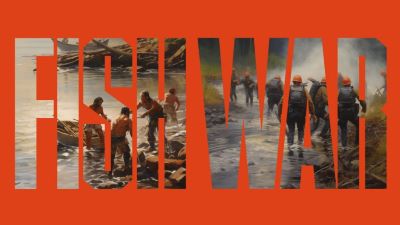
Fish War is a film about the past, present, and future of tribal treaty and fishing rights. The first one-third of the film recounts ways the State of Washington and non-Native commercial and sport fishers ignored and undermined tribal treaty rights and federal law when they obstructed tribal citizens’ access to fishing. This battle for recognition of treaty rights led to U.S. v Washington, the federal court case presided over by Judge George Boldt which resulted in the finding that tribes are entitled to 50% of the annual fish harvest, a decision commonly known as “the Boldt Decision.” The balance of the film discusses ways tribes have utilized the Boldt Decision to advance treaty rights through fisheries, intertribal cooperation, co-management with State of Washington, and more. One tribal member characterized the impact of Boldt as, “A moment when culture started to come alive, come back, when tribes started exercising sovereignty and self-governance in new ways.”
The ruling did more than recognize tribes’ fishing rights. It also established requirements that have professionalized tribal processes for management of fisheries, it required creation of tribal ordinances and penalties and gave tribes a foundation for increasing their expertise in new ways, which has fostered tribal self-regulation of fishing. And because the Medicine Creek Treaty said that tribes would always have fish, governments must work together to ensure fish habitats and fish passage are protected. This work, too, is an outcome of the Boldt Decision.
Fish War depicts a fraught moment in Washington’s history, but that moment did not need to be contentious. Americans typically have too little exposure to tribal histories and the fundamentals of tribal sovereignty, and states have sometimes attempted to enforce state laws where federal law supersedes. Tribes know what sovereignty is, and they understand the historical and contemporary relevance of treaties. If the State of Washington had consistently recognized treaties as the supreme law of the land and described them that way to Washingtonians, commercial and sport fishers would have been clearer about the limits of their industries.
This film features voices of tribal people who led and lived through the battle for treaty rights; each provides insights about salmon and Native lifeways. Throughout the film, tribal citizens and leaders emphasize that everything they do is for the salmon. Discussions with attorneys and scientists contextualize the legacy of the Boldt Decision and its ongoing impacts. Fish War offers an opportunity to learn not only about our shared history, but also what comes next.