
CHIYO SANADA – Japanese Calligrapher
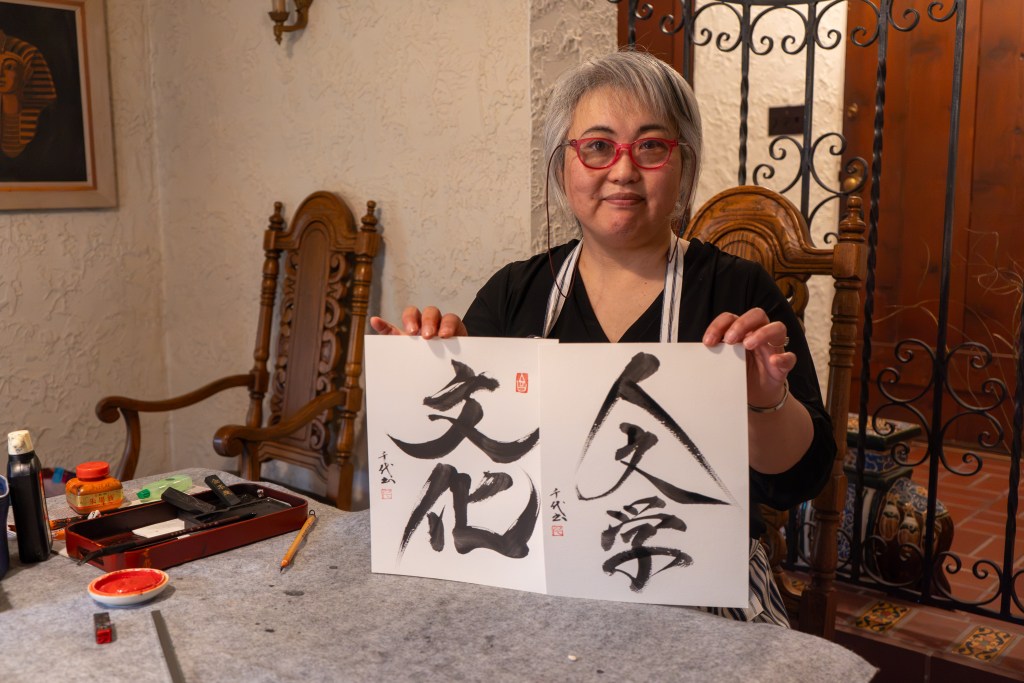
Chiyo Sanada is a Japanese calligrapher and visual artist based in Olympia, WA who sees the art of Japanese calligraphy (shodo) as both a form of self-expression and a way to connect with others.
Background
Chiyo Sanada was born in Hiroshima, Japan where she started learning calligraphy at the age of seven. Encouraged by her mother, a wonderful mentor, and the lack of homework involved, Chiyo found herself drawn to calligraphy over any other extracurricular activity. She enjoyed being able to focus intensely on her craft: “[I] just go and then concentrate, have a good time for one hour, and then practice, and go home.”
When the time came to choose a career path or shinro, Chiyo decided that she wanted to be a teacher and share Japanese calligraphy to the world. “That was my big dream when I was in high school,” Chiyo recounted. She then went on to earn a teaching certificate and a degree in Japanese calligraphy at Hiroshima Bunkyo University.
Chiyo moved to Washington state in 2000 and has since exhibited numerous art works, collaborated with various artists using different Japanese art forms, and given countless workshops and demonstrations.
An Educator at Heart
Chiyo is highly skilled in engaging folks of all ages and skill levels in learning calligraphy. Her lessons are easy to follow and full of memorable pneumonic devices that help students visualize the required strokes—
“so this almond, 45 degrees, re-press, straight down, repress whipped cream, sharp seven…. banana, tip from the inside, add pressure, and then swan, go away […].”
That is just a sample of colorful instructions one might hear from her during a workshop. The ease with which she can translate complex brushstrokes for complete beginners comes as no surprise given that she taught up to 100 people, many of them kids, almost every day for five years back in Japan. Had Chiyo stayed in Japan rather than moving to the US, she believes she would have focused on teaching calligraphy rather than exploring new ways to create her own art using Japanese calligraphy.

Ta-me, ma
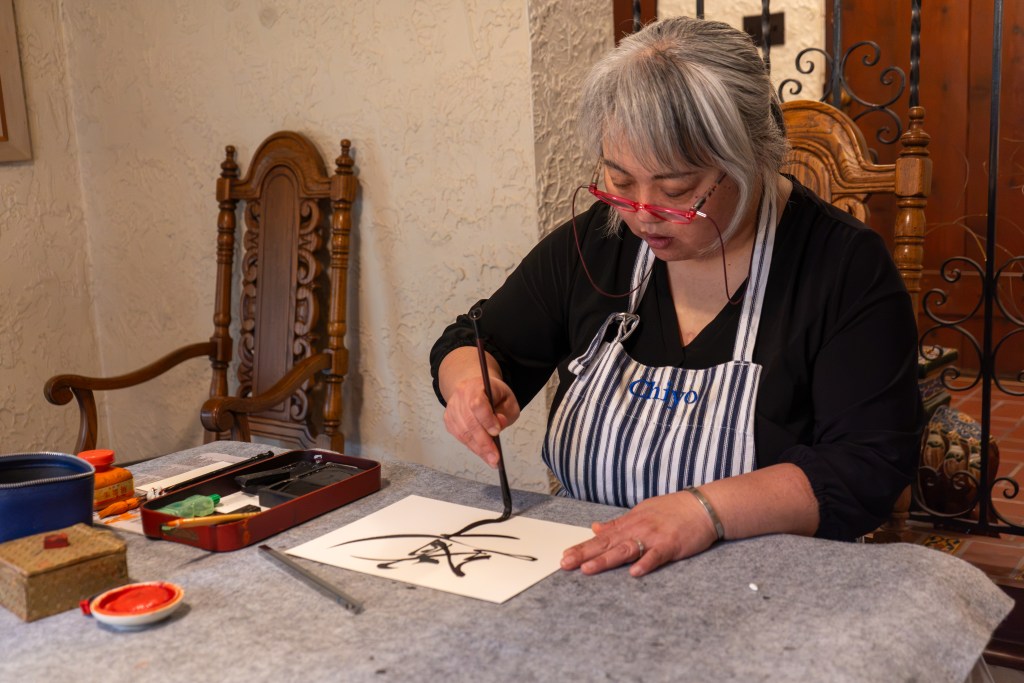
When asked about the nuances of Japanese calligraphy, Chiyo talks about the idea of ta-me, which she says roughly translates to taking pauses. Such pauses are essential for creating ma or gaps where invisible connections between strokes can take place. She likens it to giving a speech in front of a large audience where pauses or silences help to effectively capture attention. Chiyo also emphasizes the importance of balance and how negative spaces are crucial for creating such balance.
“Like so, for example, this [character] means flower, this is flower. Do this, and then go this [way], something like that. So, I always think about beginning and then ending, and then try to look for this—some empty negative space to make a balance, and try to not go too far this way, because I want to go explore this way. If you make it too [symmetrical], it’s not fun. So, always unbalance and balance, and the negative, and then not negative […] In America, Western culture, when we [write] ABC, do you think about the negative space and positive space? So that’s why writing, writing, writing, writing is so… how do you say? It’s just writing. But in Japan, we need to think about how to connect each line…”
Chiyo believes that giving importance to such silences, pauses, and negative spaces which may not be readily evident in Western artistic forms are essential in practicing Japanese calligraphy.
Calligraphy and Artistic Style
Chiyo shared with WACultures staff some of the strictures of having to adhere to different schools (shuha) of Japanese calligraphy. If you belong to certain school, “it’s hard to get out,” Chiyo says. One would have to get permission to engage in various activities or engage in a certain style. One may even have to pay the school or master a fee for participating in a competition. “I just didn’t want to do that kind of stuff,” Chiyo admits.
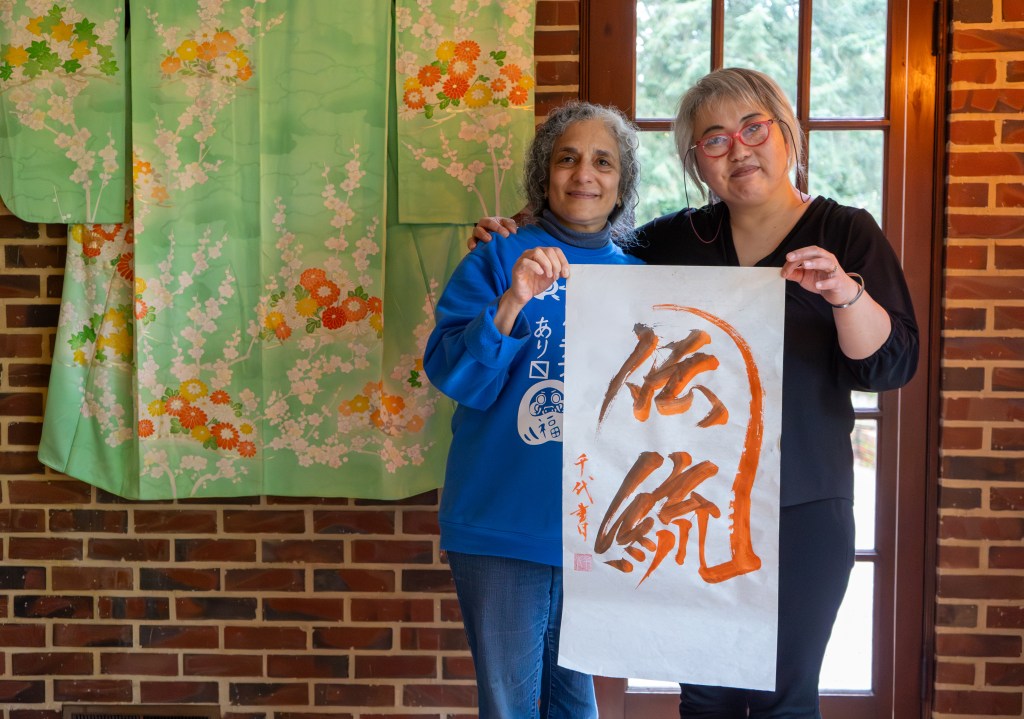
Choosing to practice calligraphy in her own way, Chiyo then considers herself as not belonging to a particular school of Japanese calligraphy, saying that she is more of a lone wolf. Her apprentice Lisa counters, “She’s more of a free spirit. That’s why I appreciate her style.”
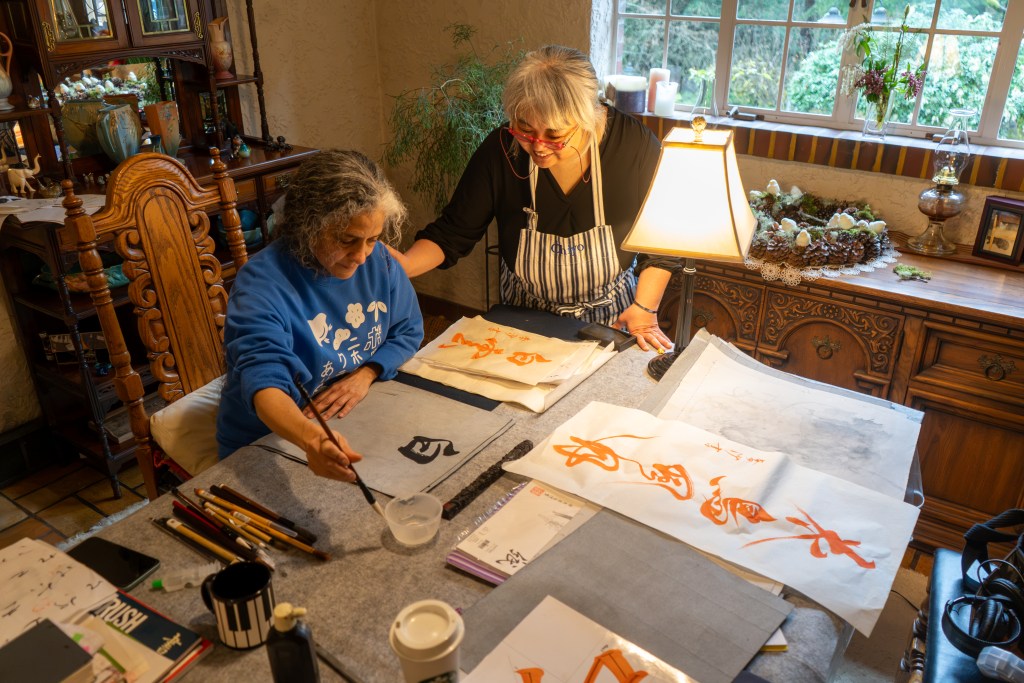
Chiyo, in fact, experiments by incorporating various colors, illustrations, and other visual elements with Japanese calligraphy. For example, she has fused corporate logos with Japanese characters for some commissioned work. She has also collaborated with Japanese artists practicing other art forms, such as by holding calligraphy demonstrations alongside taiko (drum) performances. Chiyo’s apprentice, Lisa, is effusive in her praise for Chiyo’s innovations.
“She turned the [Japanese] character for a snake into a snake, you know? […] and she did the same thing for [the character for] horse this year, and she was trying to teach me how to do that, and of course, that’s impossible […] she combines writing in art, and she fuses it into one in a way that I’ve not ever seen in any other calligraphy artists.”
What is Japanese calligraphy to you?
For Chiyo, Japanese calligraphy was a lifeline that helped her connect with others. She confides how difficult it was in the first few months after having moved to the US with limited English skills. Even though she considered herself outgoing, those early years were dark and scary. Then she found that others were interested in learning calligraphy. This helped her open up and connect with people. If not for calligraphy, Chiyo says, “I would not have survived living in Seattle.”
At the time of writing, Chiyo had lived almost half her life in Japan and the other half of her life in the US. She feels that her time in the US has certainly changed her in some ways. She continues to see calligraphy and her art as a way to get to know people and connect with them. Now that Chiyo lives in Olympia, she considers it her mission to bring more of Japanese culture to this region but, she says, “I’m still figuring out, too.”

2025-2026 Heritage Arts Apprenticeship Program
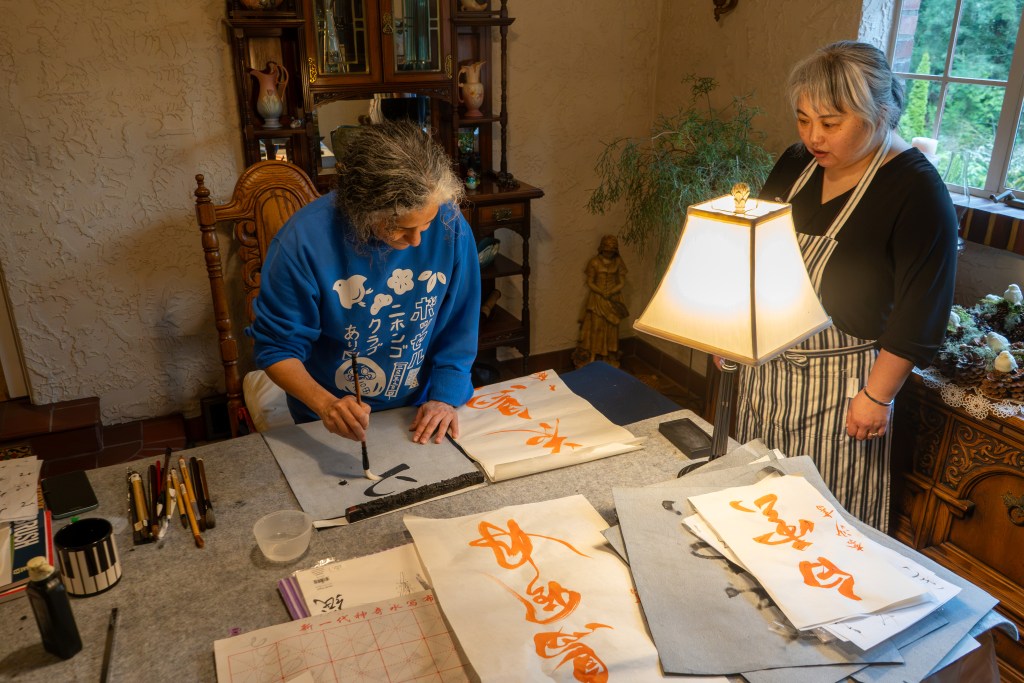
As a 2025-2026 Heritage Arts Apprenticeship Program Master Artist, Chiyo mentored Lisa Marie d’Aquila (Lake Forest Park, WA) and Max Boone (Olympia, WA). Max, Chiyo’s 14-year-old son, spent about half an hour two or three times a week to practice Japanese calligraphy and saw a lot of improvement in his brushstrokes. Lisa, who has had previous experience doing Japanese calligraphy, focused on mastering writing the basic Japanese alphabet called hiragana, while also learning the earlier variants of hiragana called hentaigana. Later on, she would learn the practice of connecting those characters into what is known as renmen. Finally, Lisa would take on writing Chinese characters or kanji on larger canvases or sheets of paper.
Chiyo also participated in WACultures’ Makers Space booth at the 2026 Northwest Folklife Festival where she provided festival goers an opportunity to engage in Japanese calligraphy. Families with young children, teenagers, and adults of all backgrounds enjoyed trying out calligraphy on so-called “magic paper” which uses water that dries off and disappears in seconds, and black Sumida ink on paper to write kanji and/or their names in Japanese script.
Apprentice: Lisa Maria d’Aquila
Lisa Maria d’Aquila has always been fascinated with Japanese culture. She spent a year in Japan as a high school exchange student when she took several cultural classes including flower arranging, sewing, other arts and crafts, but calligraphy drew her interest the most. She later worked in Japan for three years as part of the Japan Exchange and Teaching (JET) Program. She used that opportunity to continue learning calligraphy. Since coming back from Japan, she has pursued a different career but has continued using her Japanese language skills and cultivating her love for Japanese culture by volunteering with the Japan-America Society of Washington.
Through her volunteer work with the Japan-America Society of Washington, she came to know Chiyo and was drawn to her style of calligraphy. Lisa vividly remembers, “I walk[ed] into her classroom, and she’s got this incredible calligraphy all over the room, and I’m going, ‘This is [going to be] my teacher’”.
She approached Chiyo a number of times after that first meeting to learn calligraphy but it wasn’t until they came to know of the Heritage Arts Apprenticeship Program that it became possible for Chiyo who lives in Olympia, and Lisa who lives in Lake Forest Park, to meet for calligraphy lessons.
Lisa has high praise for Chiyo who she says combines writing and art, in a way that she had never seen before in other calligraphy artists. “That’s what I value so much,” she tells WACultures staff and Chiyo, “that’s the reason why I insisted on having you for my teacher, and nobody else, because nobody else does this […] the world literally does not know [what a] genius she is […].”
Learn more about Chiyo www.chiyosanada.com
Chiyo in the Media
“Chiyo Sanada Calligraphy Artist”. The International Examiner. 17 February 2010.
Erickson, Anne. “Olympia Calligrapher Paints with Feeling”. King5 Evening. 15 March 2022.
Gilmore, Molly. “Chiyo Sanada’s artful calligraphy honored as fall Arts Walk’s cover image”. The Olympian. 29 September 2021.